
Strategy and the Time Cone
Introduction
For the last 12 years, my work with the Institute of Directors has given me access to over 4,000 UK and international directors and leaders, ‘captive’ for three days at a time, as they undertake the Chartered Director program. On each program I have been able to gather direct, experiential information from a few key questions I ask directors on every program I run. The concepts and frameworks for this article come from answers from those 4,000 leaders to just one of these questions: “Where, as a board and as individual directors and leaders, do you spend most of your time, organisational focus and effort?”
To frame this question, I first ask: “As a director and board member what are you legally responsible, accountable (and liable) for when running a company?” Unless they have completed the Role of the Director and the Board (RDB) Program there is usually an uncomfortable shifting around in seats. Summarising and paraphrasing Sections 172, 173 and 174 of the Companies Act 2006 directors are responsible and accountable for the long-term success of the organisation and required to exercise care, skill, diligence and independent judgement and balance often competing needs of different stakeholders in achieving this success. Other formal guidance highlights the board’s role in setting strategy and leading organisations in ways to make their strategies succeed.
This top-level framing marks the start of an exploration into the reality of board life for most directors and the companies they serve. Specifically, this article surfaces the weaknesses that the majority of boards and their directors have when it comes to devising and setting effective strategies.
Strategic Time Frame
When asked about strategic time horizons there is some variation but for most directors the predominant answers cluster in the three-to-five-year range. (Note: See https://www.actinium-cs.com/insights/4blrokz5u0x90pbb4a067g7b1swu02 for an article on a coherent and cohering model for organisations).
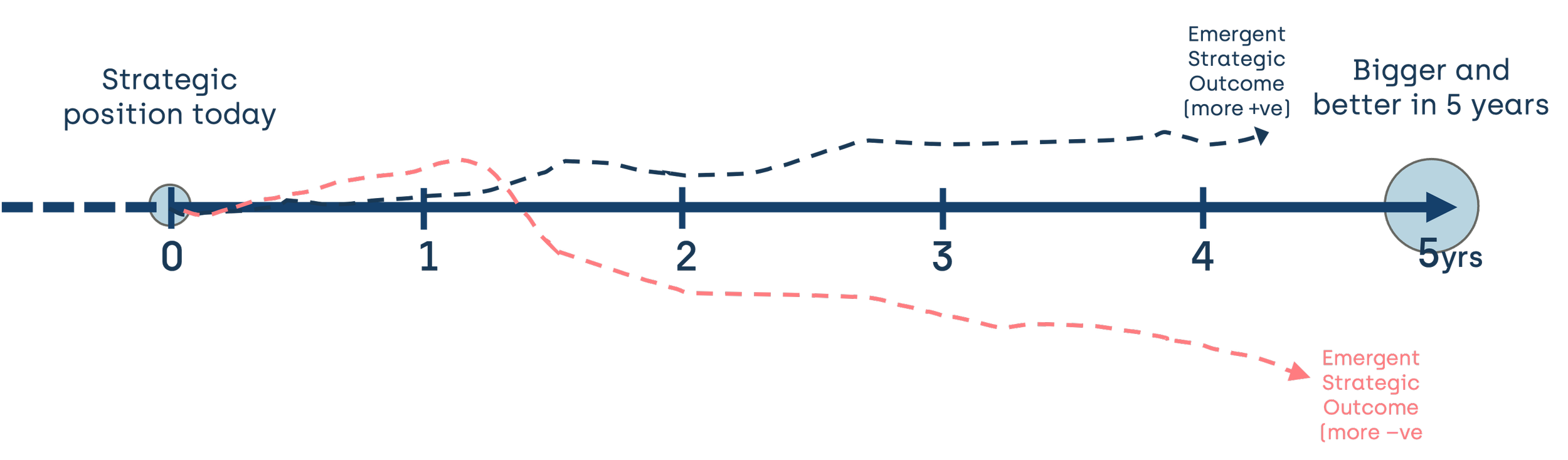
For most boards strategic thinking is relatively constrained by various interests and stakeholders but is generally driven by the overarching desire to be ‘bigger and better’ in five years’ time. I deliberately use the term bigger and better because strategic success means different things to different types of organisations. For a commercial company, it could mean increased revenue, profits and increased market share. For a high vocational, ‘for purpose’ entity it may be better outcomes for key stakeholders, for example better survival rates for patients.

There is recognition that no strategy is going to proceed with unerring accuracy straight down the planned path. The only environment where the original planned outcome is possible is with a pure monopoly company. Even then human factors are likely to conspire to alter the outcome.
Consequently, strategic performance is inevitably going to meander, with an eventual ‘emergent’ outcome that is different from that which was originally planned. It is important to note that in cases where the ‘red’ path may be the most likely outcome, showing it to key stakeholders will often be ‘career limiting’, thus it rarely appears!
Time Cone’ Thinking
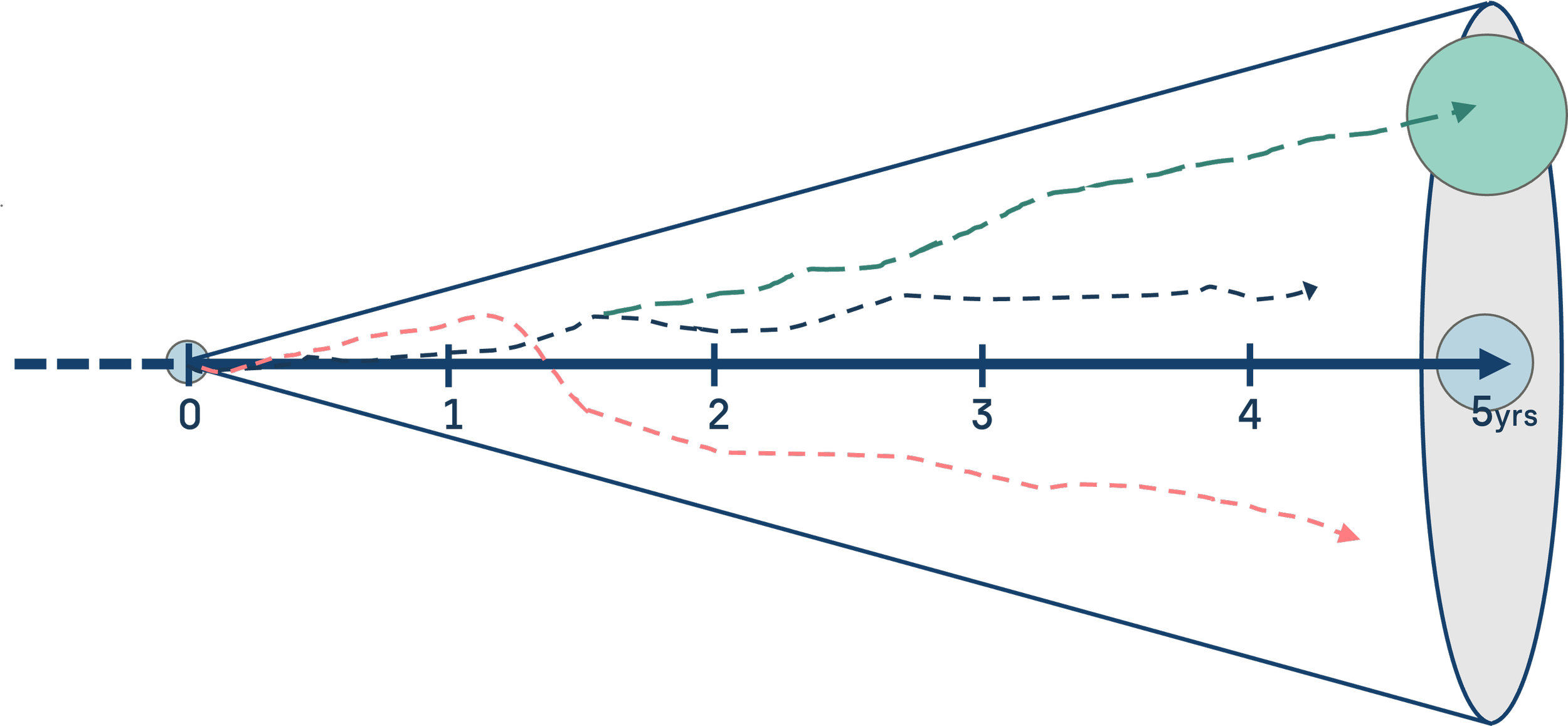
Most often, the meandering, emergent strategic paths come as a surprise to companies and their boards. This results in them reacting to unforeseen events or changes, often in knee jerk fashion, rather than proactively adapting to them because they are already sensitised to the ranges of possibilities their strategic path may open up over time. In Darwinian terms adaptation is a better bet for survival than reaction.
This brings me to my concept of time cone thinking in strategy.
In its simplest form time cone thinking is just a way of graphically helping an organisation understand, and hopefully commit to, thinking more widely and more deeply about the future when it comes strategic analysis, option generation and option choice making.
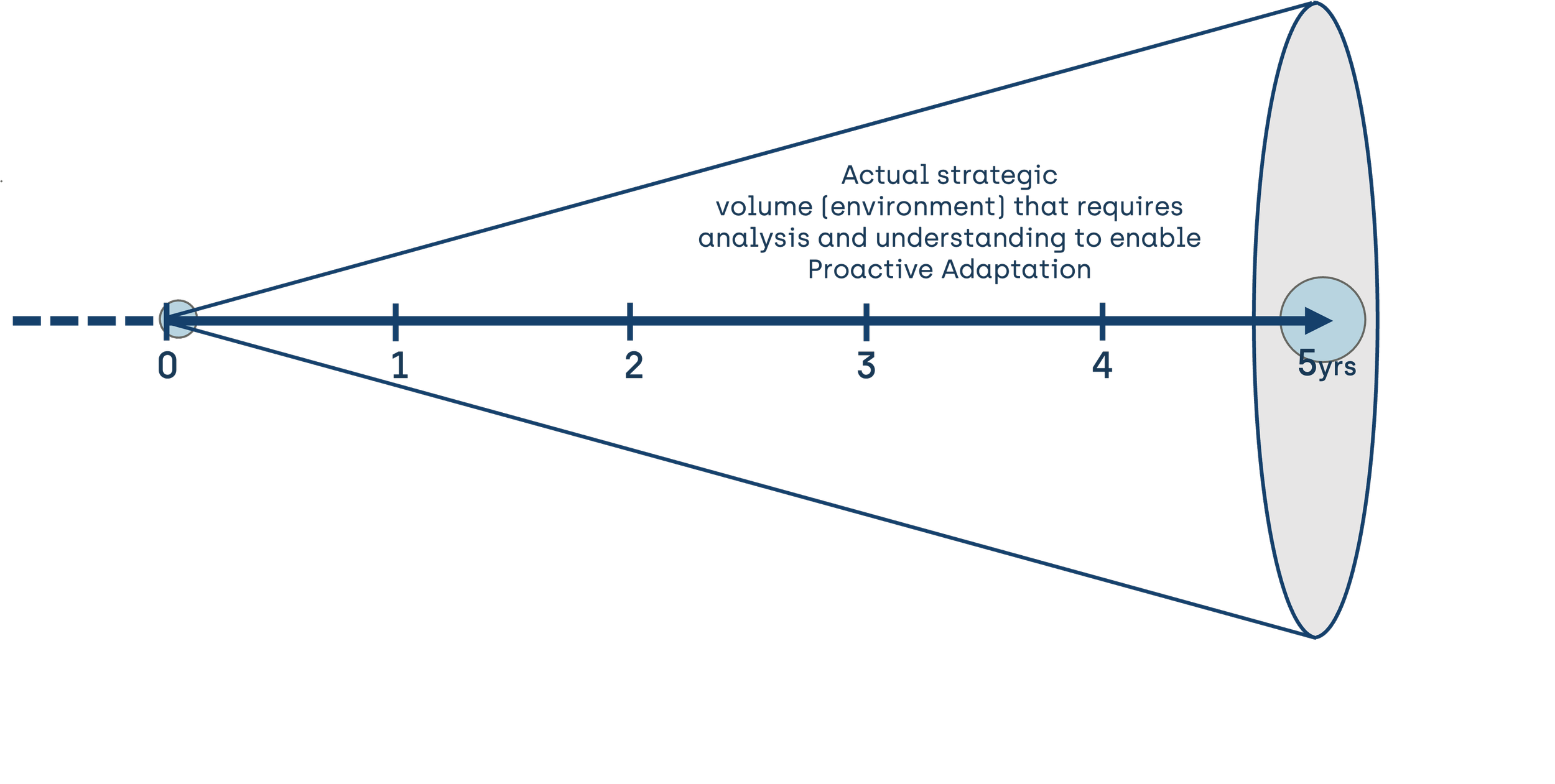
If a more thorough analysis of the wider time cone encompassed environment had been undertaken, then neither the blue nor the red dotted lines would have been a surprise. The red line could have been mitigated sooner and maybe even eradicated. The blue line may even have been able to be developed into the green one. There’s a famous saying in sports coaching circles along the lines of: ‘It’s not how well you have done but, how much better could you have done with the resources and competencies available to you?’
Strategy, Comfort Zones and ‘Time Cone’ Thinking
So far, so theoretical. Models and frameworks are great until they come up against reality. The concept of the time cone is very simple to understand but very difficult to realise in an organisational setting because of the human factors that come into play. There are numerous challenges that boards and directors face when it comes to crafting a strategy. Here are just three of the more material, human factor, challenges.
· Limited time spent time doing analysis. In action-oriented organisations, (especially prevalent in western culture type companies), ‘thinking’ is not seen as ‘doing’. Consequently, we not only feel driven to rush to action but we are often compelled to do so by outside actors (e,g. shareholders). Thus, effective analysis is cut short.
· Analysis and option generation is intellectual ‘heavy lifting’. Exploring and generating a range of rich options to choose from is difficult, demanding, intellectually effortful and time-consuming. Consequently, we often fail to generate a meaningful range of well-developed options to choose from. We limit ourselves to a quick, cursory chat about one or two (often familiar and comfortable) things we could do ….and then rush to action.
· Failing to align the company to the new strategy. Aligning an organisation takes detailed planning, effort and energy over a prolonged period. Organisational reality is that new strategies are often rushed into action and moved straight to the implementation phase with the hope that somehow the organisation will ‘align itself on the fly’ to the new things thart need doing.
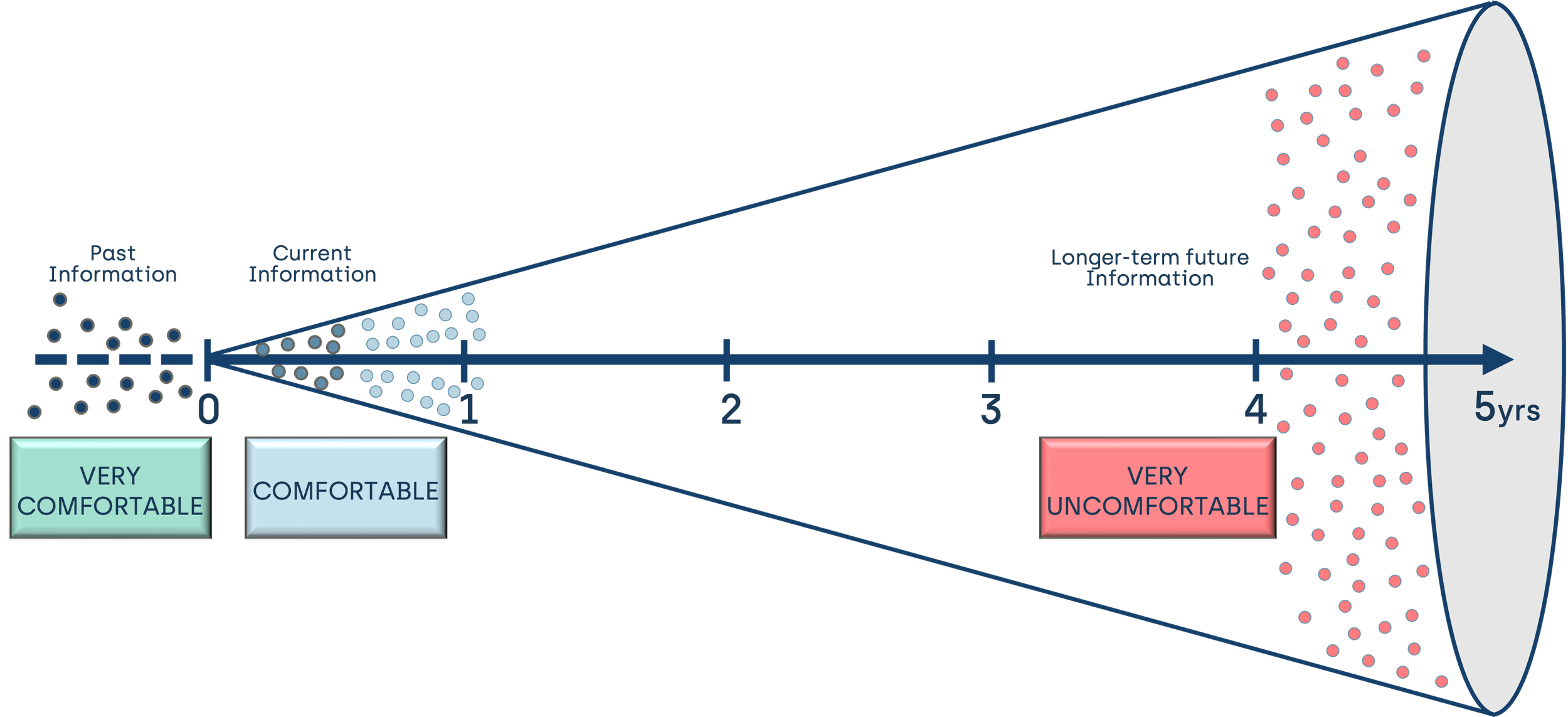
The above, among many other reasons, force most directors and boards into their comfort zones. The following progression of questions, sequenced with time zone graphics, demonstrate the comfort zone problem.
Question 1:How do we as directors feel about Past Information – i.e. relating to the past quarter, the past half year, the past year? Unsurprisingly, the predominant response from my sample group of 4,000 directors, is that we are very comfortable with it. It is information derived from all that has unequivocably already happened. It is therefore factual and reliable.
Question 2:How do we as directors feel about Current Information – i.e. relating to the next quarter, half year, year? The predominant response from my sample is that we are generally comfortable with this near-term information.
Question 3:How do we as directors feel about Longer-term Future Information – i.e. relating to the 5year strategic time horizon? The answer is that we are very uncomfortable. There is too much information, we don’t know what’s meaningful, there is too much ‘white noise’, its uncertain, it feels opaque, reliability is suspect, confidence levels are very low, etc.
Our time cone now looks like this.
Having established the baseline for directors’ feelings of comfort and discomfort, I ask the final question.
Question 4: When thinking about the agendas for your board meetings and the focus of the majority of board papers prepared for board meetings, in which areas do they predominantly focus? The answers are clear and stark – the response from more than 4000 directors is that 85% to 95% of board papers and directors’ time is focused on the short-term and the past. The inference is that because the longer-term strategic world is difficult and uncomfortable there is a retreat to the comfort zone.
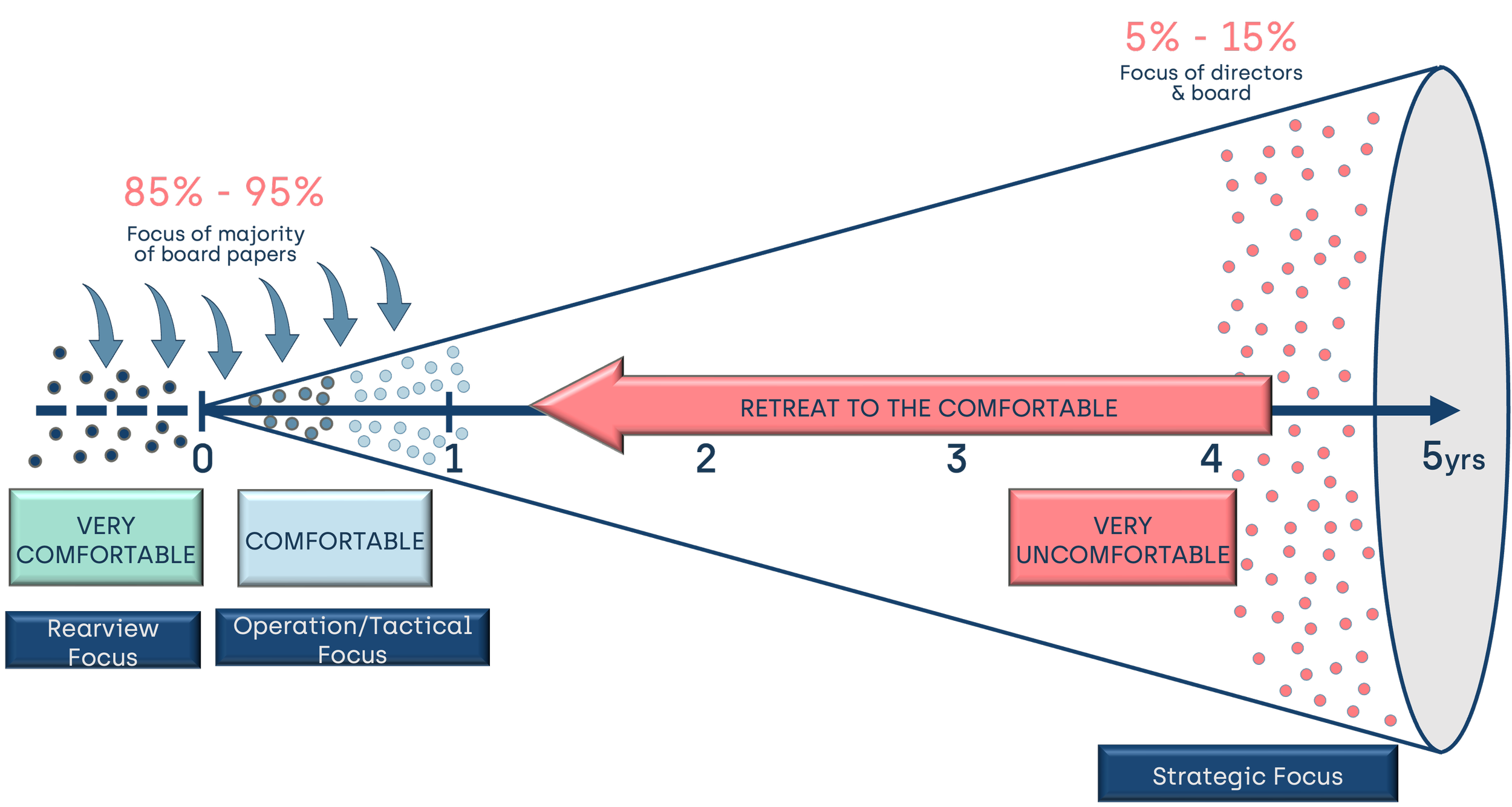
This would seem to be some way adrift from the Companies Act and other guidance addressed in the Introduction about the role, responsibility and accountability of the board and directors for the long-term success of the company.
The message seems very clear. Directors need to spend much more of their time and intellectual horsepower thinking about the full strategic time horizon (deeply and widely). They need to become much more comfortable working in what are effectively zones of uncertainty. There area many ways this can be done.
Not all Time Cones are equal
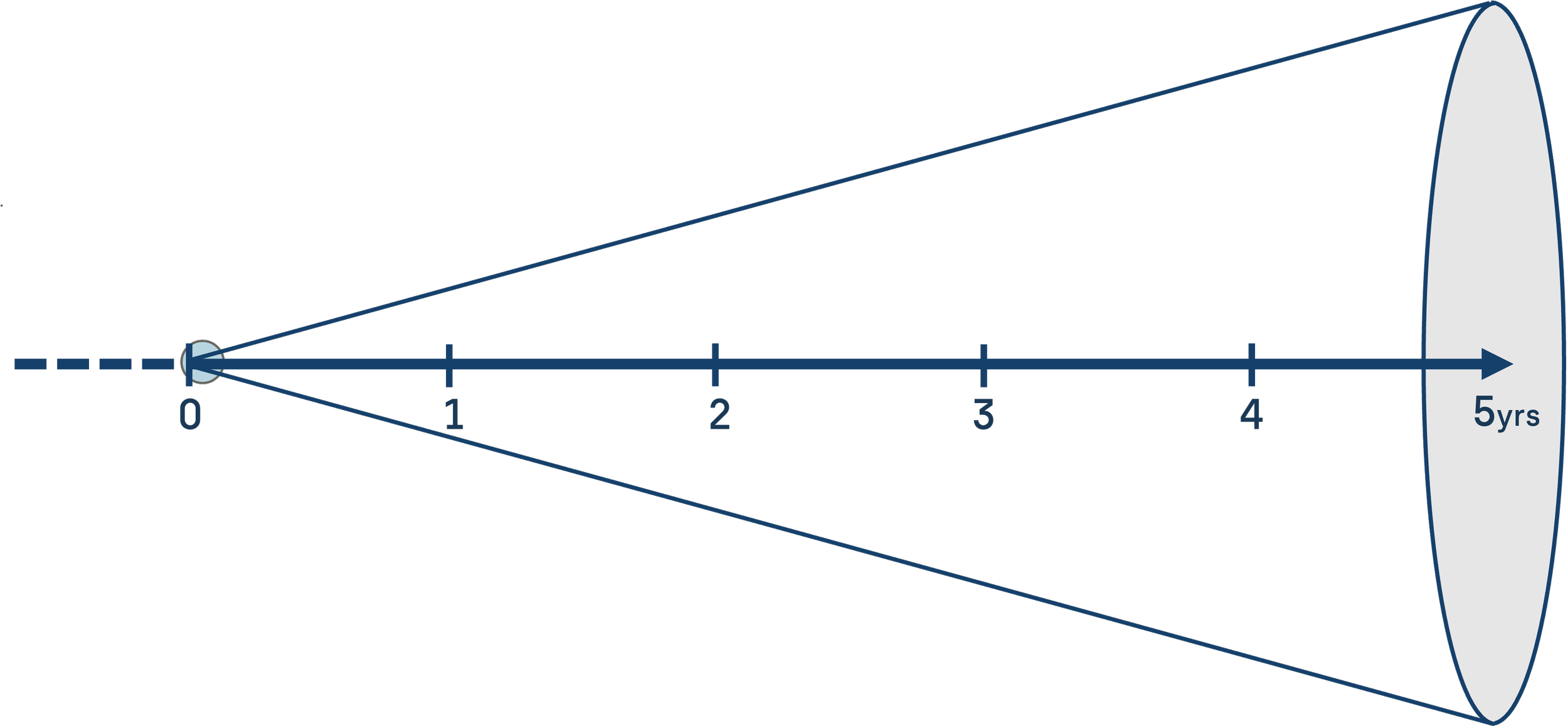
Having read the above you may now be tempted to start thinking about your own strategic time cone. At this point we need to discuss one more aspect of time cone thinking, namely – not all time cones are equal. You may be quite happy that you have committed time, energy and resources to the wider, deeper and longer term thinking with your time cone ‘span’ looking like the following:

It doesn’t look quite so impressive if your competitors have committed more time, energy and resources and have developed time cones that are greater in span – i.e. they are analysing and assessing more than you and may well develop more and better options that lead to better strategic choices.
Conclusion
Once the concept of time cone thinking becomes a normal way of considering strategy more possibilities and opportunities begin to surface. For example, think of time cones that exist in adjacent sectors. They may come to overlap with yours in future years creating currently unforeseen opportunities or fundamental threats.
If you like this model and/or have any questions or would like more detailed information, please do not hesitate to get in touch via the website: www.actinium-cs.com